Electric Power, Natural Gas
May 20, 2025
US gas-fired turbine wait times as much as seven years; costs up sharply

HIGHLIGHTS
Extremely high demand for turbines
Costs up 2.5 times in some markets
With demand for natural gas-fired turbines in the US rapidly accelerating amid power demand growth forecasts driven by AI, manufacturing, and electrification, wait times for turbines are anywhere between one and seven years depending on the model, and costs have increased considerably, experts told Platts.
As of February, original equipment manufacturers, or OEMs, "are quoting upwards of five to seven years if you are trying to order [a gas-fired turbine] right now," Bobby Noble, senior program manager for Gas Turbine Research and Development at EPRI, formerly known as the Energy Power Research Institute, said.
It does vary and some may be shorter than that, "but the fact is there's a huge buildout in growth occurring," he said.
"Three to four years sounds about right if you are not already in the queue for a turbine," Paul Sotkiewicz, president and founder of consultant E-Cubed Policy Associates, said. Sotkiewicz also served as chief economist of PJM Interconnection's market services division.
"We are seeing this across all the components needed to build a gas-fired power plant," Sotkiewicz said.
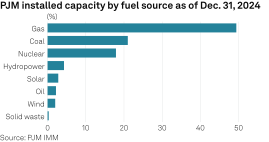
Some US regions are increasing gas-fired capacity more than others and right now data center growth is a big factor.
"Gas-fired turbines are one of the prime abilities to increase your capacity, especially on the order of what some of these data centers are looking at," Noble said.
If a data center campus needs a gigawatt-plus of power to meet demand, a two-on-one combined cycle gas turbine facility is very much capable of supplying that sort of need, he said.
"PJM, for sure, is one of those markets," Noble said.
Highlighting interest in PJM, NRG Energy said May 12 the company plans to acquire 13 GW of gas-fired generation capacity, and 6 GW of virtual power plant capacity owned by LS Power Development that have an overall enterprise value of $12 billion.
Acquiring the LS Power portfolio will increase NRG's presence in the US Northeast by 11 GW, with about three-quarters of that capacity in PJM and the remainder is in the ISO New England and New York Independent System Operator markets.
The major OEMs are also reporting solid orders for new gas-fired turbines, up significantly from just a few years ago.
"There is no question that gas turbine demand has clearly increased, especially when you consider that the market for large gas turbines for power generation applications in the United States in 2022 was limited to one -- the lowest total ever reported," Rich Voorberg, president of Siemens Energy, North America, said in an email.
Strong gas-fired turbine demand
"With the gas turbine sales and reservations that we've transacted over the past six months alone, we will add dozens of gas turbines to our operating fleet in North America," Voorberg said.
Orders in the respective business area within Siemens Energy more than doubled worldwide compared to the same quarter in fiscal year 2024, he said.
In Q2, Siemens Gas Services recorded the highest orders in a quarter to date, the company said during its earning call.
In the US, the company has planned gas turbines with a total capacity of 8 GW for data centers in the first half of the year, which includes 2 GW as booked orders and 6 GW as firm reservations.
Overall, the order backlog has reached a new high of 133 billion euros, Siemens said.
"Everybody around the world is trying to order new gas turbines and the lead times are somewhere on the order of five years-plus. I'm sure there are examples that are shorter and longer but that seems to be the going number most of the OEMs are quoting," Noble said.
Wait times overall depend on the turbine frame. Between one and two years is the ballpark across all frames and there are a lot of variations, according to one OEM.
Competition is "very fierce" at the moment and those who wait longer to place an order will end up waiting a longer time to receive their equipment, the company said.
Cost increases
The costs of gas-fired turbines and other power plant equipment have risen in recent years due to supply chain issues that have yet to recover after the pandemic, as well as higher inflation and other factors.
"It's not just the length of time but the costs have gone up tremendously for a new gas-fired power plant. A new GE H-class combined-cycle facility would cost about $2,400/kW," Sotkiewicz said.
"We did a quote and to do the same kind of unit that had been built a few years back it would be two and a half times more today," he said.
Noble agreed.
"We are seeing substantial increases in the estimates for new builds, including everything from the cost of engineering, procurement and construction to the cost of equipment and materials," he said.
And the wait times and cost increases are related.
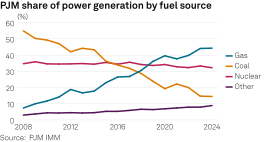
"Costs reflect wait times. Now, everybody wants to get a turbine," Sotkiewicz said, adding that there was a lull in the US after the "dash for gas" but demand worldwide kept up.
"Now there is not enough bandwidth, he said."
The dash for gas refers to the US shale gas production boom that led to a period of historically low gas prices when a lot of gas infrastructure was built.
"We are seeing this across all the components needed to build a gas-fired power plant," Sotkiewicz said.
Uncertainty around the depth and direction of international tariffs initiated by the Trump administration creates an additional wildcard for those in the gas-fired turbine market.
"Costs were going up – pre-tariff – so after tariffs it's hard to say what that looks like," Sotkiewicz said.
GE Vernova and Mitsubishi Power did not respond to requests for comment.

Editor: